StormCenter logo

Archive

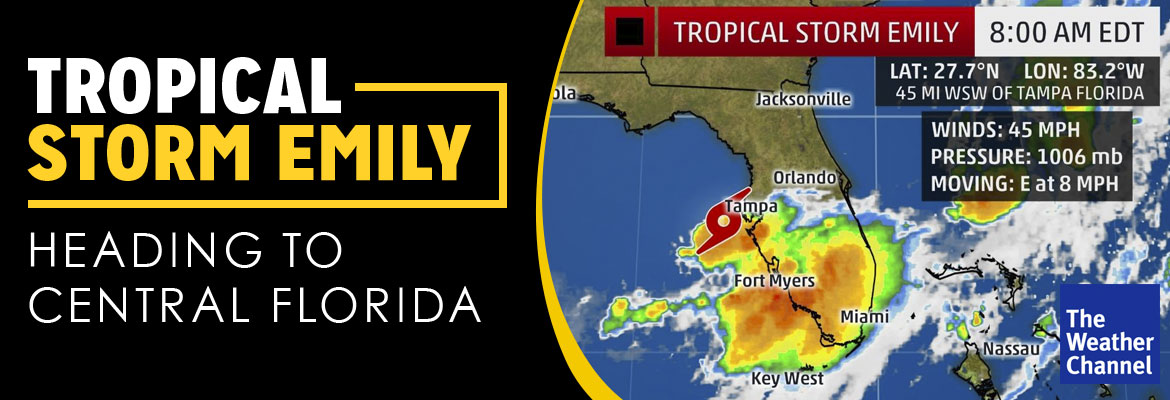
Tropical Storm Emily Heading to Central Florida

SECO Energy is monitoring Tropical Storm Emily as it passes through its service area today and Tuesday.


Tropical Storm Emily, formerly named Tropical Depression Six, formed off the coast of Tampa early Monday morning. The storm is heading east at 8 miles per hour and is expected to trek eastward across Central Florida today, impacting SECO’s service area.


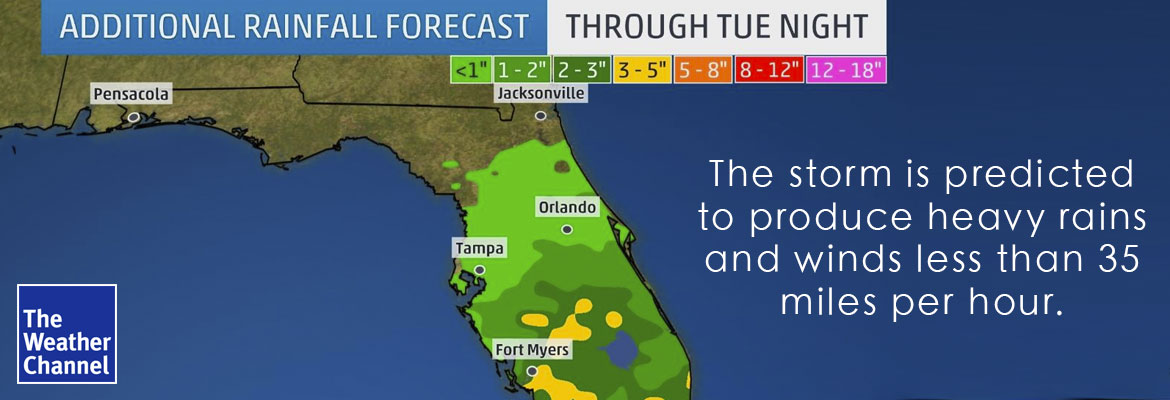
The storm is predicted to produce heavy rains and winds less than 35 miles per hour. The forecast is still mostly uncertain, Tropical Storm Emily developed very quickly from a depression to a tropical storm overnight. The storm should make initial landfall near the Tampa Bay area.


The system is not expected to develop intensity and will be through Florida and into the Atlantic waters early Tuesday morning.

SECO Energy is Storm Ready, Tropical Storm Emily is predicted to produce heavy rains and winds less than 35 mph


SECO employees are Storm Ready and waiting to respond if outages occur from Tropical Storm Emily. Tropical Storm Emily will be the first storm to impact Central Florida during the 2017 Atlantic Hurricane Season. SECO is prepared for the possibility of inclement weather and would like to remind members that it is best to be informed and prepared.


SECO offers storm preparation tips and an emergency checklist online. As a not-for-profit electric cooperative, SECO is dedicated to being our members’ first source for accurate storm information. “Like” SECO’s Facebook page and “follow” the company on Twitter to stay updated about storms affecting our area.

$500 in Back-To-School Funds for The Villages Charter School

As a not-for-profit electric cooperative, SECO Energy is committed to supporting education in the school districts in its service area. As part of SECO’s new back-to-school initiative, The Villages Charter School is receiving $500 to enrich back-to-school activities for the school.


The funds are intended to support events like back-to-school teacher luncheons, new teacher welcomes and training sessions. The funds can also be used to support back-to-school events for students and parents such as after school back-pack programs and school supplies needs.


CEO Jim Duncan stated, “SECO serves over 45,000 members in The Villages, and we know the school will make good use of these funds for back-to-school programs. As a not-for-profit electric cooperative headquartered in Central Florida for almost 80 years, SECO believes that supporting education creates strong community partnerships. SECO’s school support initiative is a positive step for education in our area.”


Dr. Gary Lester and Dr. Randy McDaniel of The Villages Charter School Board gave a special recognition to SECO and our Board of Trustees member Richard Belles during Thursday’s Board Meeting.


Education is a key cooperative principle, and SECO has long supported local students. For more than two decades, SECO has awarded scholarships to graduating high school seniors who live in a home served by SECO. During this 20-year program, upwards of $500,000 was awarded to over 250 local students to help them fulfill their dreams of a higher education.


Energy Services Specialists from SECO Energy often visit with local students to spread the word about electrical safety, solar power and saving energy. Presentations and speakers are available for groups and civic clubs of all ages. These presentations are like an educational field trip that comes to the schools and saves the time and expense of running buses. Request a speaker and presentation online or call 352-793-3801.


Learn more about SECO Energy’s commitment to community online. “Like” SECO’s Facebook page and “follow” @SECOEnergy on Twitter for news releases and cooperative updates.

$1000 in Back-To-School Funds for Citrus County Schools

As a not-for-profit electric cooperative, SECO Energy is committed to supporting education in the school districts in its service area. As part of SECO’s new back-to-school initiative, the Citrus County School District is receiving $1,000 to enrich back-to-school activities in Citrus County.


The funds are intended to support events like back-to-school teacher luncheons, new teacher welcomes and training sessions. The funds can also be used to support back-to-school events for students and parents such as after school back-pack programs and school supplies needs.


CEO Jim Duncan stated, “SECO serves over 15,000 members in Citrus County, and we know the school district will make good use of these funds for back-to-school programs. As a not-for-profit electric cooperative headquartered in Central Florida for almost 80 years, SECO believes that supporting education creates strong community partnerships. SECO’s school support initiative is a positive step for education in our area.”


Education is a key cooperative principle, and SECO has long supported local students. For more than two decades, SECO has awarded scholarships to graduating high school seniors who live in a home served by SECO. During this 20-year program, upwards of $500,000 was awarded to over 250 local students to help them fulfill their dreams of a higher education.


Energy Services Specialists from SECO Energy often visit with local students to spread the word about electrical safety, solar power and saving energy. Presentations and speakers are available for groups and civic clubs of all ages. These presentations are like an educational field trip that comes to the schools and saves the time and expense of running buses. Request a speaker and presentation online or call 352-793-3801.


Learn more about SECO Energy’s commitment to community online. “Like” SECO’s Facebook page and “follow” @SECOEnergy on Twitter for news releases and cooperative updates.

$3000 in Back-To-School Funds for Marion County Schools

As a not-for-profit electric cooperative, SECO Energy is committed to supporting education in the school districts in its service area. As part of SECO’s new back-to-school initiative, Marion County Public Schools is receiving $3,000 to enrich back-to-school activities in Marion County.


The funds are intended to support events like back-to-school teacher luncheons, new teacher welcomes and training sessions. The funds can also be used to support back-to-school events for students and parents such as after school back-pack programs and school supplies needs.


CEO Jim Duncan stated, “SECO serves over 56,000 members in Marion County, and we know the school district will make good use of these funds for back-to-school programs. As a not-for-profit electric cooperative headquartered in Central Florida for almost 80 years, SECO believes that supporting education creates strong community partnerships. SECO’s school support initiative is a positive step for education in our area.”


Education is a key cooperative principle, and SECO has long supported local students. For more than two decades, SECO has awarded scholarships to graduating high school seniors who live in a home served by SECO. During this 20-year program, upwards of $500,000 was awarded to over 250 local students to help them fulfill their dreams of a higher education.


Energy Services Specialists from SECO Energy often visit with local students to spread the word about electrical safety, solar power and saving energy. Presentations and speakers are available for groups and civic clubs of all ages. These presentations are like an educational field trip that comes to the schools and saves the time and expense of running buses. Request a speaker and presentation online or call 352-793-3801.


Learn more about SECO Energy’s commitment to community online. “Like” SECO’s Facebook page and “follow” @SECOEnergy on Twitter for news releases and cooperative updates.

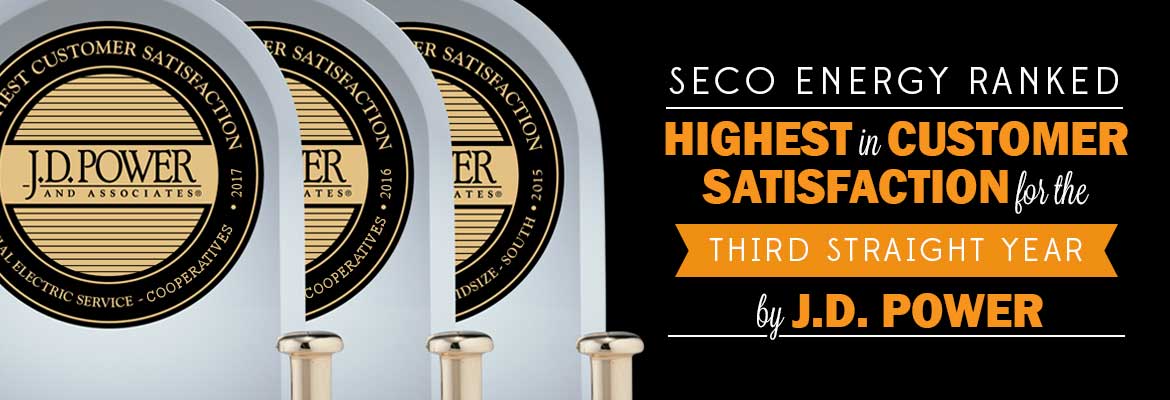
SECO Energy Ranked Highest in Customer Satisfaction for the Third Straight Year by J.D. Power

SECO Energy ranks highest in customer satisfaction among all electric cooperatives nationally according to the J.D. Power 2017 Electric Utility Residential Customer Satisfaction Study released yesterday.


This latest J.D. Power award is the third consecutive J.D. Power award for the not-for-profit electric cooperative that serves seven counties in Central Florida. In 2015, SECO was ranked “Highest in Customer Satisfaction Among Midsize Utilities in the South.” This year and in 2016, SECO Energy was named “Highest in Customer Satisfaction Among Cooperatives.”


The J.D. Power study measures customer satisfaction with electric utility companies by examining six factors: power quality and reliability; price; billing and payment; corporate citizenship; communications; and customer service.


CEO Jim Duncan stated, “SECO Energy employees are the best of the best – our employees are the true winners of any award the cooperative receives. A special thank you to our employees, senior leadership and the Board of Trustees. Our people are the heart of SECO, and they make a difference for our members. This year’s J.D. Power award is a tangible representation of how SECO members feel about the cooperative as a whole. I am beyond delighted with our company’s Triple Crown. I am grateful and humbled by the praise and goodwill from our members.”


The Board of Trustees President, Ray Vick is proud to be a long-time Board member. Vick stated, “Member satisfaction is a top priority at SECO. On behalf of the Board, I extend my heartfelt thanks to the employees for their dedication to our members and the cooperative. We couldn’t be prouder of you and your accomplishments.”


This third J.D. Power award culminates a decade-long effort to increase reliability, maintain low rates and provide world-class customer service. SECO’s score of 789 is a 20-point increase over its 2016 ranking. SECO is proud to retain its title as “Highest in Customer Satisfaction Among Cooperatives.”


Learn more about SECO Energy on our About SECO page. “Like” SECO’s Facebook page and “follow” @SECOEnergy on Twitter for news releases and cooperative updates.

Nature’s Reflections – Hurricanes & Wildlife

Where do animals go in a hurricane?


Florida’s wildlife is well adapted to the state’s weather extremes. Their early warning system lies in the ability to sense any change in the barometric pressure and move to safer locations. Members of the animal kingdom seem to find places to hide from a storm’s wrath.


Water birds and shorebirds move inland during storms. Many birds will fly to the outer edge of a storm and find a safe place to hunker down – sometimes hundreds of miles away. Birds have the ability to tighten their grip and hold on during high winds, just as they do when sleeping. Cavity nesters, like woodpeckers will often ride out the storm in the tree. Many species of wildlife know the areas of the forest where they will be best protected from the worst winds. Chicks in a twig or ground nest are at the highest risk for injury.


Natural disaster disrupts and affects everything in its path, including wildlife. Livestock and pets are not always able to get out of harm’s way on their own. A sad fact is that there is usually some loss to wildlife and habitat as a result of severe storms. The good news is that wildlife in general is amazingly resilient.


While we can never place animal life above human life, it is important to be sensitive to the needs of both wildlife and domestic animals as much as we can before and after a natural disaster.


Nature's Reflections - Hurricanes & Wildlife, Disaster disrupts and affects everything in its path, including wildlife


Following the 2004 hurricanes, FEMA brought in veterinarians from other states to help rescue and treat the thousands of domestic animals that resided in the Florida counties that were declared federal disaster areas.


The Humane Society collected pets found disoriented and wandering aimlessly and gave them food and shelter until the rightful owners could be found. Those unclaimed pets were later offered for adoption.


Volunteers from area wildlife rehab centers were busy with rescue and treatment of injured, displaced and orphaned animals following the hurricanes. Biologists from Florida’s Fish and Wildlife Conservation Commission (FWC) monitored the impact to wildlife for weeks following the storms. Research shows that most of Florida’s ecosystems and wildlife populations recover, or adapt, quickly after even the severest storms.


Column & photos by Sandi Staton – sandi.staton@gmail.com


Read the full Nature’s Reflections article in the July 2017 SECO News here.


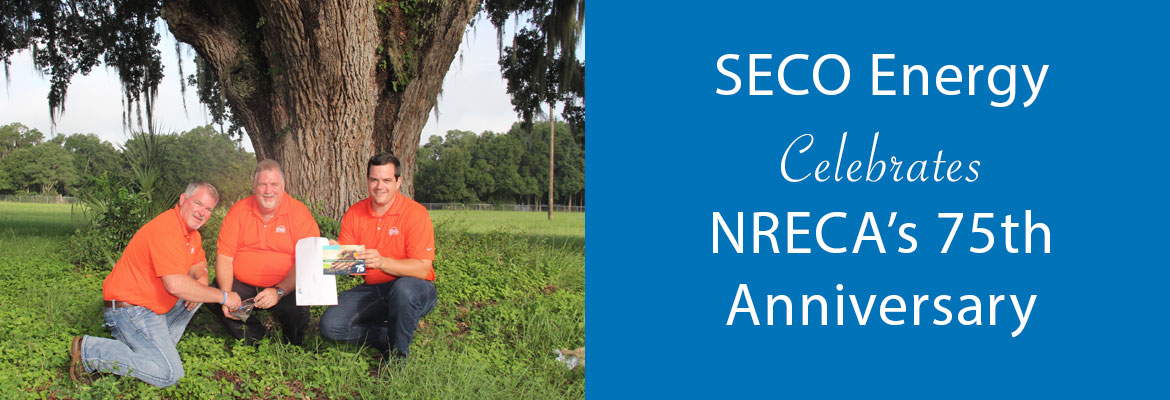
SECO Celebrates NRECA’s 75th Anniversary

SECO Energy and its fellow electric cooperatives across the nation are teaming up to bring a tree to life at National Rural Electric Cooperative Association (NRECA) headquarters in Arlington, Virginia.


SECO Energy’s Vegetation Management employees collected soil from its Sumterville headquarters and sent it to the NRECA. The NRECA will use the soil collected from SECO and its other electric cooperative members across to the country to plant a commemorative tree in honor of its 75th Anniversary.


The NRECA is the service organization for electric cooperatives, including SECO Energy, working to promote and support co-ops and be a champion for the cooperative business model. In the way that the NRECA and its member cooperatives nourish and support each other, the collected soil will used to nourish and support the 75th Anniversary commemorative tree.


SECO Energy CEO Jim Duncan stated, “SECO is pleased to partner with our fellow electric cooperatives by sending a small piece of SECO to celebrate the NRECA’s 75th Anniversary. Collectively, NRECA’s electric cooperative members across the country are a strong, tight-knit unit of co-ops delivering safe, affordable electric service to over 42 million homes and businesses every day.”


Learn more about SECO Energy and its cooperative roots. “Like” SECO’s Facebook page and “follow” @SECOEnergy on Twitter for news releases and cooperative updates.

Energy Insider – 2nd Quarter

SECO Energy Insider, 2nd Quarter - Avoid Taking the Bait When Hackers Phish

Avoid Taking the Bait When Hackers Phish


Online phishing emails are a very real and dangerous trend. According to Wikipedia, the annual worldwide impact of phishing was as high as five billion dollars as of 2015. Today, this number is substantially more.


Being aware of what phishing emails look like and how to avoid them can save a company a lot of money, damage, and stress. Computer hackers love to go phishing, but instead of baiting hooks, they’re sending emails. They disguise what looks like a trustworthy email in order to obtain sensitive information from companies and individuals. Phishing is a form of social engineering designed to trick people into clicking what appears to be a valid link but instead causes damage in one way or another.


The reason hackers phish is to obtain sensitive and profitable information. By clicking on the link in their email, you may be doing anything from installing a virus to allowing the hackers into your computer network. Either of these is to gain information to be used against the company or for access to sensitive information such as a social security number or password. For example, the hacker may obtain a company’s username and password to their bank account and start making money transfers. They may gain trade secrets or future plans. This vital information is up for grabs if someone is not careful when receiving a phishing email.


Phishing emails are designed to blend in with emails employees receive every day. For example, if you work in the accounting world and are accustomed to emails with invoices, you might receive the same type of email from a hacker with only a couple of variations. One may think that a small change isn’t a big deal, but that little detail could make all the difference. Often, the emails give a time frame or sense of urgency in order to prompt a quick click without thinking. For example, claiming your bank account is hacked and you need to click the link to reset your password. Phishing emails also often contain grammatical errors. A good example of a phishing email will look something like this:
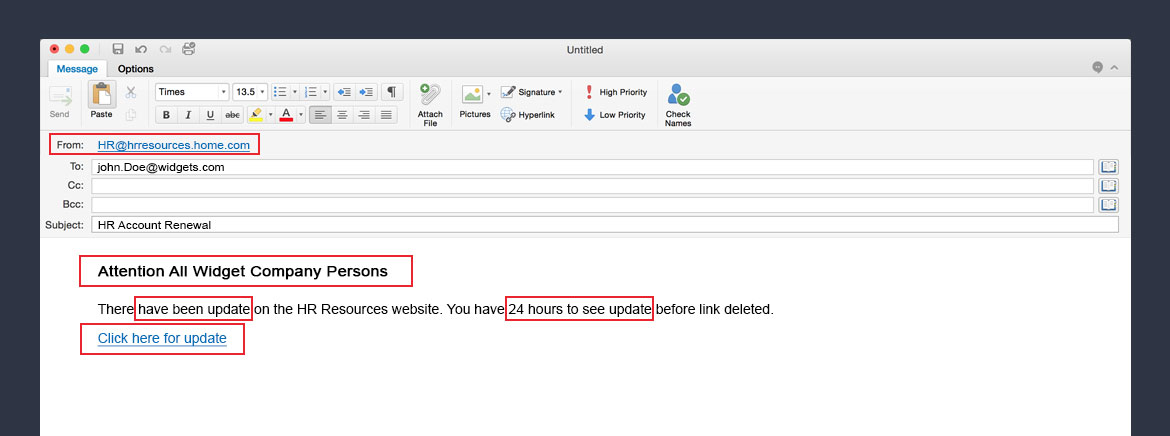
 

SECO Energy Insider, 2nd Quarter - Avoid Taking the Bait When Hackers Phish, phishing email example


The easiest way to avoid falling victim to phishing emails is to always pay close attention. The “From” portion of the email address will often be similar to email addresses you would normally recognize. The slight difference could be as simple as an extra letter. Many times the sentences are not well written.


If an email is not one you’re expecting, question why it is being received. If the email is suspicious in any way, check with your company’s IT security team. If you receive an email asking to change a password for anything from a bank to a medical insurance site, call the company first or go directly to the website instead of clicking the link. Always check the legitimacy of the email before moving forward and warn others so everyone knows to be wary of a possible incoming attack.
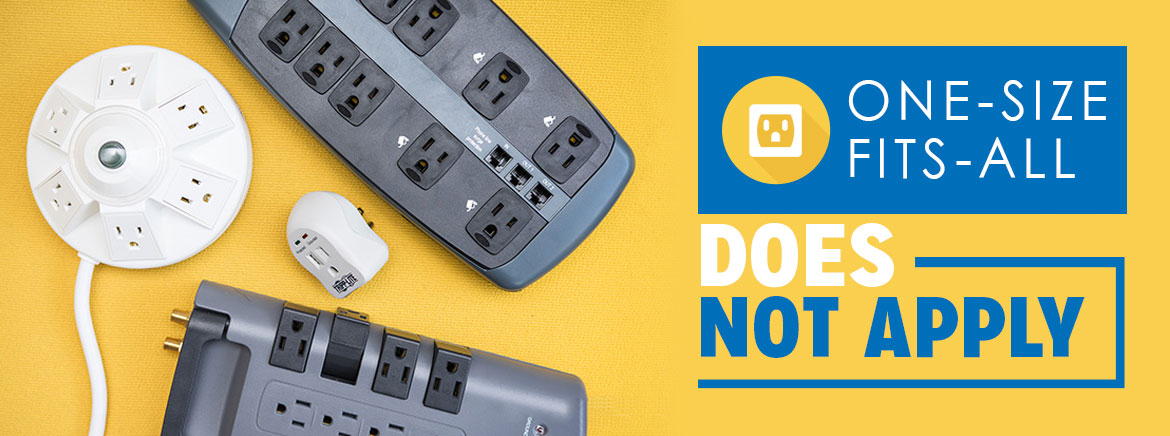


SECO Energy Insider, 2nd Quarter - One-size-fits-all Does Not Apply

One-size-fits-all Does Not Apply


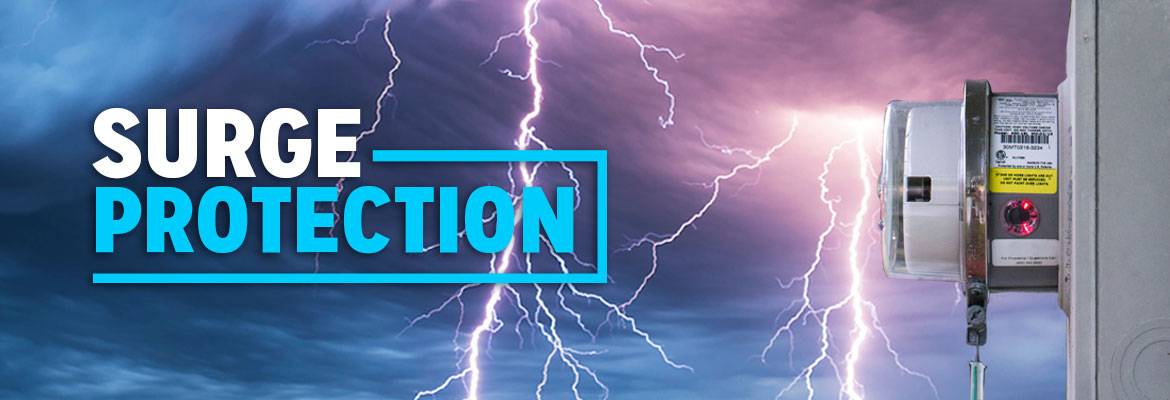
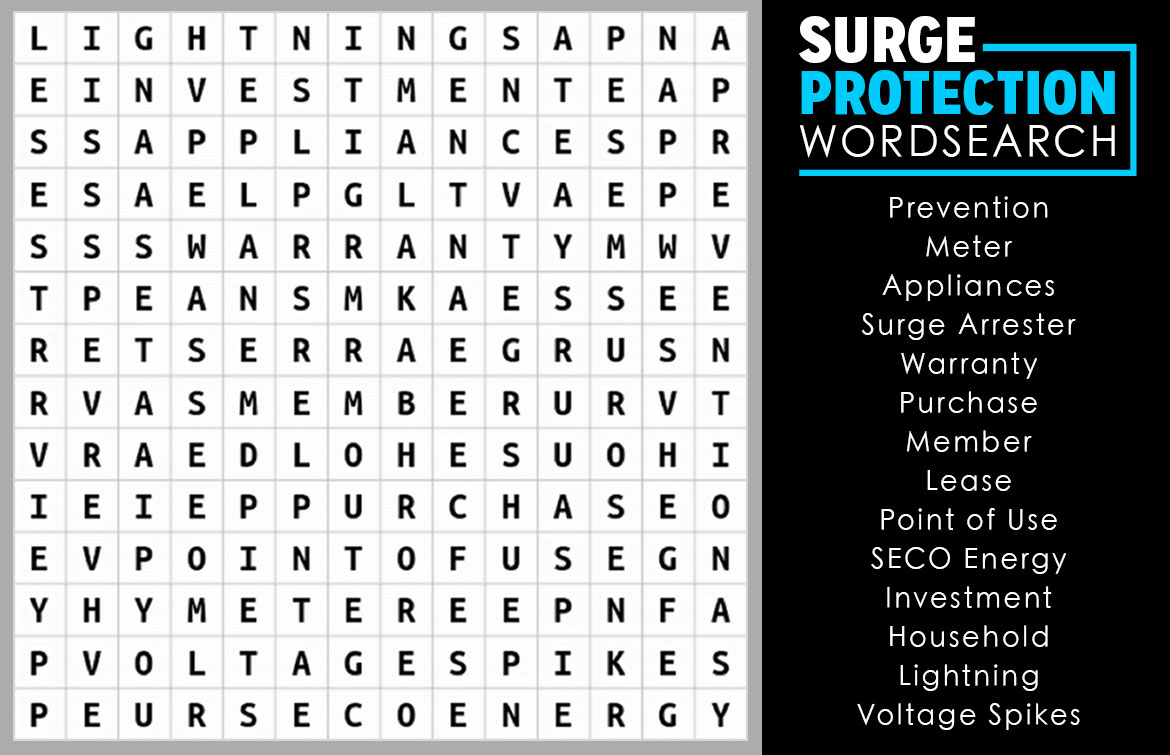
When it comes to surge protection, there is not a one-size-fits-all solution. Sometimes consumers spend a lot of money on surge products only to be disappointed. Typically this doesn’t relate to the product itself, instead, it’s because the manufacturer’s recommendations for installation have not been followed, contributing to poor product performance.


When contemplating surge protection think about multiple layers of protection. The goal should be to make sure the protector is installed as close as possible to the source you’re trying to protect. Let-thru voltages increase for every foot of excess wire used in an installation. This means additional unwanted surge energy can travel directly to your equipment/systems increasing the potential for damage. The rule-of-thumb is to use as little wire as possible, avoid loops and bends, and follow instructions as outlined.


Although installation is a key factor in ensuring success, without a properly connected ground at the service entrance, dollars spent on surge protection are spent in vain. Have a professional test your grounding effectiveness before you get started. Once grounding is confirmed, draw a circle around your facility. Take a look at all lines coming in such as the electric, phone, satellite, and cable. Then determine the best way to protect each point of entry.


Besides primary surge protector at your service entrance or before the first breaker in your main panel box, add protection at all subpanels. Pay careful attention not to forget panels feeding security systems, outdoor lighting, gates, fountains, etc. Utilize point-of-use devices on indoor equipment such as computers, copiers, fax machines, and phone chargers. Statistics show up to 80 percent of power surges are generated internally. Although these are not the surges that do the most damage, they degrade equipment over time.


For more information on how to protect your commercial/industrial facility from damaging surges contact your SECO Energy Key Accounts Consultant. We’ll be glad to arrange for our surge vendor to help you formulate a plan to fit your company’s specific needs.



SECO Energy Insider, 2nd Quarter - Member Spotlight, E.R. Jahna Industries

Member Spotlight: E. R. Jahna 474 Sand Mine, Clermont, Florida


E.R. Jahna Industries is American-owned and has been independently operated since 1934 from their headquarters in Lake Wales Florida. Building upon his construction and concrete background, Emil Jahna, Jr., started mining operations in 1946 supplying sand for local businesses producing concrete. Beginning in the late 1960s, E.R. Jahna’s Central Florida locations allowed them to flourish by supplying construction grade sands to Disney World, Interstate 4 and the surrounding building growth. Throughout the 1970s and 1980s, E.R. Jahna Industries purchased and started several new mines to expand their Florida footprint.


Today, E.R. Jahna remains owned and operated by the second and third generations of family. They continue to grow in the mining industry currently operating four sand mines in Florida and one in Savannah, GA. The company is a leading producer of high quality and reliable aggregate products – specifically sand. However, the term aggregate applies to a broad category of either fine or coarse particulate material such as silica sand, gravel, slag or crushed stone. These products are mined and used in concrete, concrete products, construction and every day modern life applications. Drain fields, road base, materials for concrete, sand for golf courses, roof tile, power poles, pavers, concrete pipe, concrete block and beach replenishment are all typical uses of aggregates here in Florida.


Although sand mining may sound simple, it is not! It requires a huge investment and an involved process to ensure a high quality product to meet end-use expectations. At E.R. Jahna’s in Clermont, Florida (served by SECO Energy), a dredge is used to remove sand from a pit. The sand is then transported through a pipeline to the sand plant. The sand plant washes and separates material through different processes to meet the customer’s end-use requirements. During its journey through the plant, the sand is screened of foreign debris, washed, sized, and the water removed creating the final sand aggregate product(s). Because the sand is so hard and abrasive on the metal processing equipment, continuous maintenance is required to meet production schedules and customer needs. E.R. Jahna’s maintenance program is key to its reliable production capabilities and quality products.


In order to compete in a competitive marketplace, E.R. Jahna continues to increase efficiency in extracting aggregates companywide. Many projects include sand plant re-configurations, efficient pump and motor upgrades, and an extensive geologic analysis of reserves and production yields. Over the next year, the E.R. Jahna 474 Independent Sand Mine will see drastic capital improvements including the total rebuild of the sand plant. With new technology and continued learning, E.R. Jahna can remain competitive and on the forefront of the aggregate mining industry.


SECO Energy Insider, 2nd Quarter - SECO Energy Is “Storm Ready,” Are You

SECO Energy Is “Storm Ready,” Are You?


Hurricane season began on June 1st and SECO Energy stands “Storm Ready.” Our System Operations Center is staffed 24 hours a day, 7 days a week and crews and support staff are available around the clock. Our Emergency Restoration Plan serves as a guide to ensure the timeliest restoration of service even under the most adverse circumstances. SECO Energy’s operating plan is continually evaluated and updated annually because we understand the importance of electricity to your business. However, this is only half the battle. You too must be storm ready.


For your business, being storm ready may not necessarily apply to a weather event or service interruption at your location. Depending on your operation, there could be a number of things with the potential to impact your bottom line. Having a plan in place to deal with concerns increases the chances of your business surviving. Statistics show that ninety percent of companies fail within a year unless they can resume operations within five days after a catastrophe.


In today’s world, businesses must prepare for the impacts of many hazards including natural disasters like hurricanes, tornados and flooding. Then there are human caused hazards, acts of violence and terrorism, technology-related issues and equipment failures. Whether the disaster is major or minor, anything that has the potential to cease operations at your location for a prolonged period of time can be crippling. A good plan is necessary to prevent this.


Many experts advise developing a preparedness plan consisting of the five steps as follows:


  1. STEP ONE-Program Management
    Assign an administrator to organize, develop and identify the regulations that establish the minimum requirements of your program.
  2.  

  3. STEP TWO-Planning
    Gather information and examine ways to identify, assess, prevent and reduce hazards and risks. Done correctly, this would include a business impact analysis.
  4.  

  5. STEP THREE-Implementation
    Create a written plan to address resource management, emergency response, communication, operational continuity, IT, employee assistance, incident management and training.
  6.  

  7. STEP FOUR-Testing and Exercises
    Evaluate your plan on an ongoing basis by conducting multiple types of training and exercises, using the results to evaluate the effectiveness of the plan.
  8.  

  9. STEP FIVE-Program Improvement
    Establish a cycle of review and methods of evaluation and make the necessary changes to keep the plan current.


Related to your hurricane preparedness plan, be sure your plan includes actions to be taken before, during and after the storm. Keep the lines of communication open for everyone involved. It is imperative employees understand their assignments and reporting procedures. Be sure site issues, such as boarding up buildings, securing or relocating signs or equipment and removing loose debris, are done before the storm’s arrival. After the storm, wait until the area is declared safe before proceeding to survey damage. Then, survey the site for safety hazards, downed power lines, leaking gas or fluids and damage to foundations or piping. If you lose power, report the outage to your SECO Energy representative and visit our Storm Center and Facebook at SECOenergy.com for progress updates and to monitor restoration efforts.


Remember, you are not alone. There are many resources to assist you in preparing for disasters. FEMA, the State of Florida and the Small Business Administration all have resources available on-line including free sample emergency plans, preparedness checklists and templates.



SECO Energy Insider, 2nd Quarter - Energy Conservation Tips for Small Retailers

Energy Conservation Tips for Small Retailers


Saving energy makes good business sense. Not only is conserving energy good for the environment, but it’s also good for your bank account. Implementing a few simple energy conservation strategies can help reduce your monthly energy bill.


Historical Usage
By monitoring your energy usage on your monthly electric bill you can identify patterns and understand normal monthly consumption. Knowing how and where energy is consumed is a first step to reduce costs and lower consumption.


Energy Efficient Equipment
Whenever possible, upgrade or retrofit light fixtures to CFLs or LEDs and consider adding occupancy sensors to turn lighting off in storerooms or other seldom-used areas. Make it convenient to unplug all equipment, not in use, with the aid of a power strip.


Control Your Thermostat
Many offices seem to have ongoing thermostat wars that can actually decrease your energy efficiency and lead to higher energy bills. Prevent this by investing in a programmable thermostat. According to ENERGY STAR® you can save $180 annually. Additional savings can be achieved if you program a more conservative setting during unoccupied hours.


Keep the Heat Outside
Ensuring your business is properly insulated and taking steps to reduce drafts can help lower your monthly bill. Door seals, window coverings, and door closers are just a few examples of low-cost ways to conserve energy.


For more information on how to save, contact your SECO Energy representative and arrange for a free personalized energy assessment of your facility.




BARBIE SHAW

Manager of Key Accounts & Energy Services
OFFICE: (352) 569-9787
CELL: (352) 303-3567
barbie.shaw@secoenergy.com

Hank Bolduc, SECO Energy Key Accounts Consultant

HANK BOLDUC

Key Accounts Consultant
OFFICE: (352) 569-9789
CELL: (352) 303-3546
hank.bolduc@secoenergy.com

Ryon Meyers, SECO Energy Key Accounts Consultant

RYON MEYERS

Key Accounts Consultant
OFFICE: (352) 569-9781
CELL: (352) 636-9593
ryon.meyers@secoenergy.com

J.D. Simmons, SECO Energy Key Accounts Consultant

J.D. SIMMONS

Key Accounts Consultant
OFFICE: (352) 569-9790
CELL: (352) 303-3183
jd.simmons@secoenergy.com


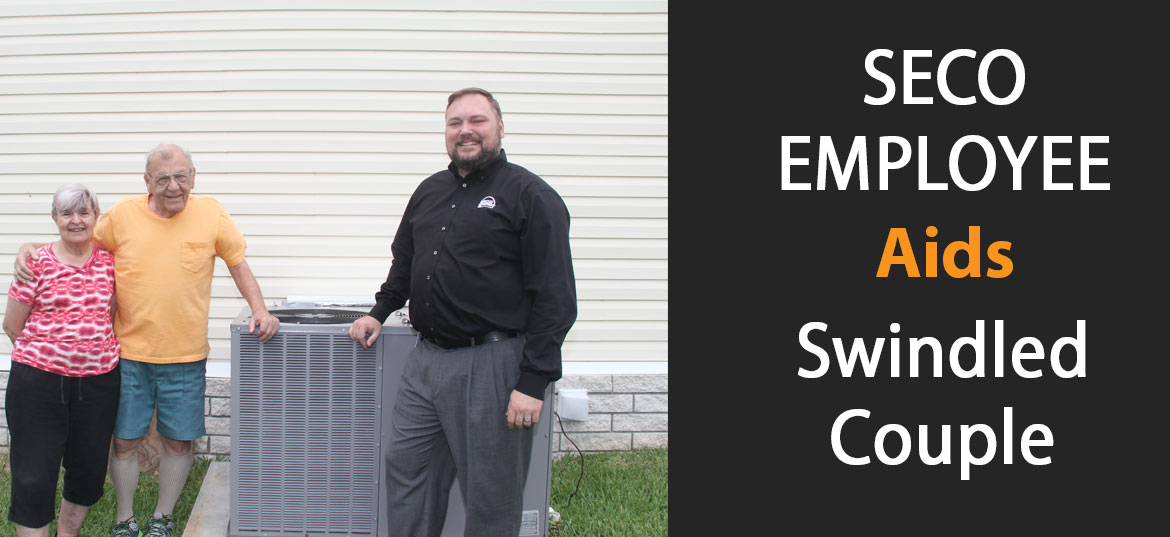
SECO Employee Aids Swindled Couple

SECO Energy’s Robert Stevens, an Energy Services Specialist, possesses the brain of an investigator and the heart of a philanthropist. Robert answered the call when an elderly couple required SECO’s assistance, found the cause of the members’ energy-use concerns and provided aid when they needed it most.


SECO helps members save energy and lower their bills by performing energy audits on members’ homes.The request may be in response to a bill that is abnormally high or from members who are simply looking for ways to save energy by making small changes in their homes/lifestyles.


In early May, SECO members Mr. and Mrs. George Somariva who reside in Lady Lake, received an electric bill that was much higher than usual. The Somarivas were concerned because of a previous, negative experience with their home warranty company and its contractor, so they called SECO for help. Within just a few days, Robert visited the Somariva’s home, completed an energy audit and found the problem. Mr. and Mrs. Somariva’s heat strips were heating the home at the same time the A/C was running to cool the home – causing the high energy usage.


In early 2016, the Somarivas contracted with a home warranty company that included HVAC services. The home warranty company sent a technician and there was significant confusion over what needed repair/replacement. In the end, the Somarivas gave the contractor a check representing a $2,000 deposit for a new unit. The check was cashed but they never heard from the contractor again.


SECO reached out to the contractor and to the home warranty management. Unfortunately, their recollections are contradictory. Some recompense was offered by the home warranty company but the Somarivas were not made whole. The couple contacted Seniors vs. Crime with their story and the agency helped them file complaints with Florida’s Department of Business and Professional Regulation against both the contractor and the home warranty company. Seniors vs. Crime determined that the contractor was not licensed as his online profile suggests and that he has a criminal record in Florida.


The Somarivas paid for a home warranty. They paid a contractor sent by the home warranty company. Once Robert determined the heat strip issue with the AC unit, they had to pay a reputable HVAC company to fix the problem – to the tune of $500.


After this large outlay, the Somarivas remained distressed because they still had two high energy bills to pay. Robert’s heart went out to the retired couple. He asked SECO to help these long-time members with their energy-use issue, and SECO agreed. The cooperative allocated a donation of Angel Funds from the company’s Pennies from Heaven program to offset the high electric bills.


Robert offers this advice to SECO members, “If you believe you have a problem with your HVAC unit, call SECO first. A trained Energy Services Specialist will conduct a home energy audit, and we can usually help members identify the cause of an HVAC problem. SECO’s no-cost energy audit can potentially save members thousands in needless HVAC repairs or replacements recommended by contractors looking to make a quick buck.”


The Somarivas are grateful to SECO for help during this ordeal. Mr. Somariva stated, “I’m glad we called SECO and spoke to Robert. He’s a knowledgeable guy, he found the problem quickly, and we had it repaired the same day. It’s a shame that Total Maintenance of Tampa won’t stand by their warranty or their word and that their contractor, Chris Martin, was not reputable or licensed. But we are thankful to SECO and Robert for their help.”


SECO Energy members can make an appointment for a free in-home energy audit at their home or conduct an energy audit online with SECO’s Home Energy Assessment. “Like” SECO’s Facebook page and “follow” @SECOEnergy on Twitter for news releases and cooperative updates.